Secures Top Honors at RoboCup Japan Open 2024
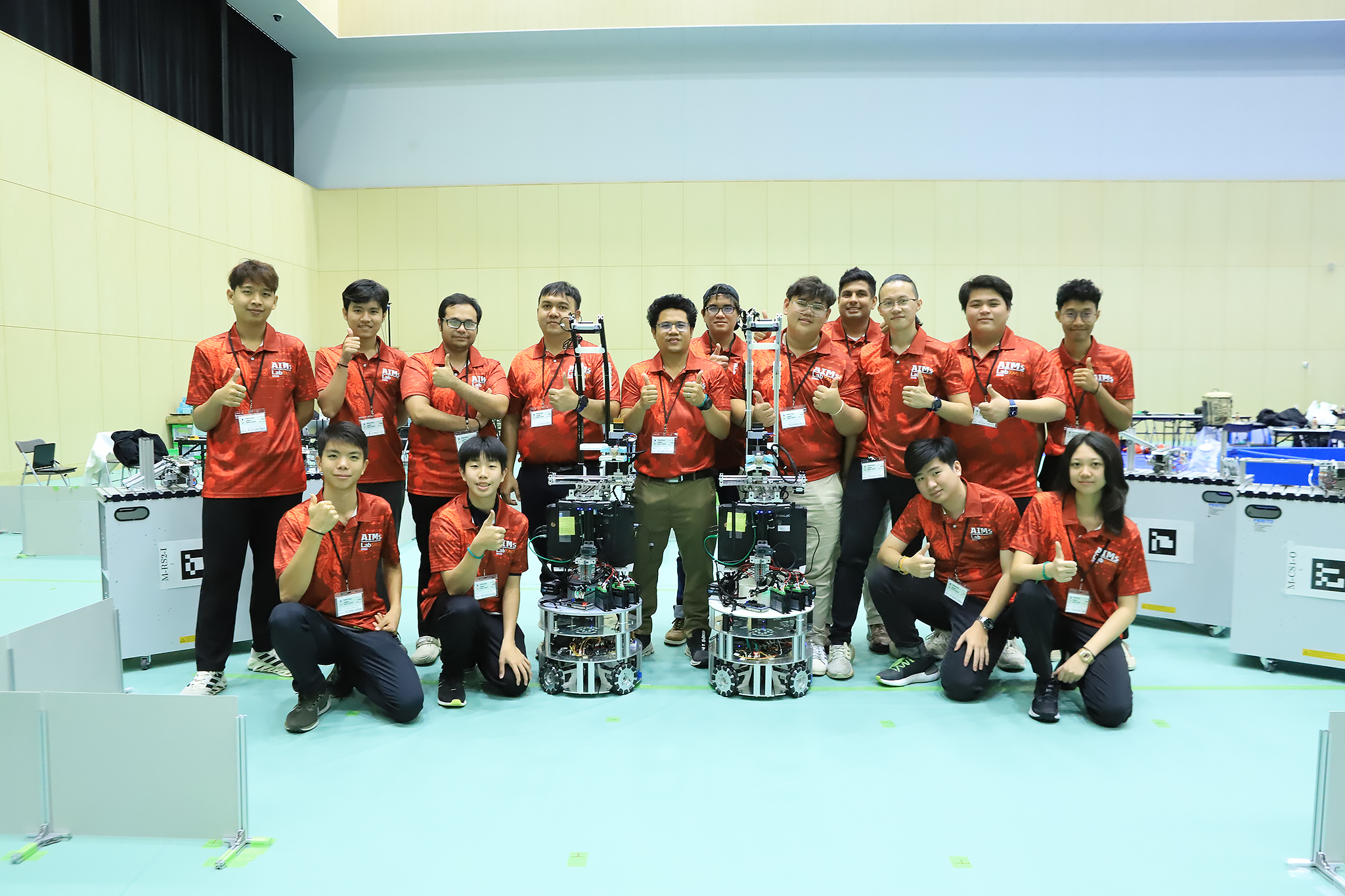
29/04/2024 – We are proud to announce that our research team at AIMsLab has achieved outstanding success at the RoboCup Japan Open 2024, securing First Place in the prestigious Industrial Logistics Challenge (ILC) held in Japan.
The RoboCup Japan Open is an internationally recognized robotics competition that brings together leading university research labs and engineering talent from across Asia and beyond. The RoboCup Logistics League (RCLL) focuses on the future of Industry 4.0, challenging research labs to design and deploy fully autonomous mobile robots (AMRs) capable of dynamic task planning, real-time material handling, autonomous navigation, and complex factory orchestration.
Key Achievements & Innovations
During the intense multi-day competition, our lab demonstrated cutting-edge advances in autonomous system engineering, including:
Autonomous Navigation & Vision Systems: Successfully operating AMRs in dynamic, unpredictable environments using state-of-the-art LiDAR localization and AI-based object detection.
Dynamic Fleet Management: Implementing multi-robot coordination algorithms for efficient task scheduling, resource allocation, and adaptive real-time routing.
Precision Manipulation & Assembly: Integrating robust robotic manipulators capable of accurate material pick-and-place under tight operational deadlines.
Pushing the Boundaries of Smart Logistics
This achievement reflects the dedication, expertise, and months of preparation by our student researchers, engineers, and faculty advisors at AIMsLab. By tackling real-world logistical challenges simulated in the RoboCup arena, our lab continues to drive innovations that bridge academic research with industrial automation and smart manufacturing solutions.
We extend our sincere gratitude to the School of Engineering, KMITL for their unwavering support throughout this journey.
"This victory validates our team's research direction in autonomous systems and dynamic task planning. We look forward to refining our algorithms and competing at the next global stage."
— Asst. Prof. Dr. Poom Konghuayrob, Principal Investigator